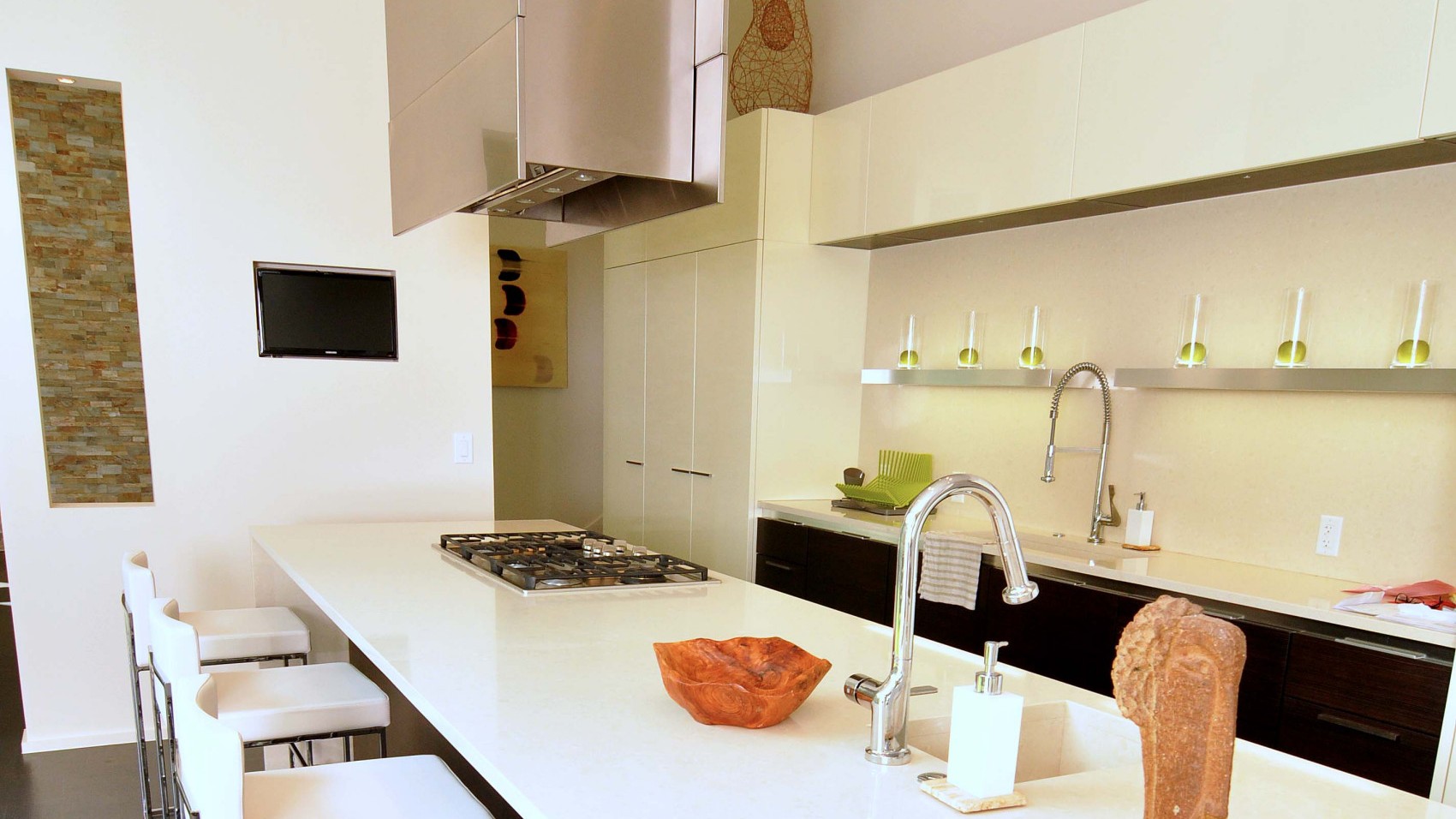
A kitchen countertop is not simply a finish selection. It affects how the kitchen looks in daylight, how it handles heat and daily use, what kind of sink can be installed, how the island is supported, how easily it can be repaired or replaced, and how the room will age over time.
At SawHorse, we help clients choose countertops as part of the complete kitchen design and our broader material-selection strategy—not as a last-minute slab decision after cabinets have been ordered. The right choice depends on the desired look, how the household uses the kitchen, the material’s maintenance requirements, the sink and edge details, and the client’s long-term expectations.
For many of our clients, the best answer is sintered stone, quartz composite, quartzite, or another natural stone. Each can be the right choice for a different reason.

Morningside Kitchen featuring Dekton sintered-stone countertops with an exposed through-body edge
Start with the way you live, not the showroom sample
Before choosing a countertop, we ask clients to consider the real demands of their kitchen.
- Do you regularly cook with hot cookware?
- Is the kitchen used heavily by a family, guests, or children?
- Do you want a material that remains visually consistent, or one that develops character over time?
- Are you comfortable maintaining and periodically sealing a natural surface?
- Is a lighter, brighter kitchen important?
- Will there be a large island, a waterfall panel, a full-height backsplash, or long overhangs?
- Do you want an undermount sink, and if so, what shape and edge detail will it require?
- Are material emissions, sealers, and installation products important considerations for your household?
There is no one countertop that is best for every kitchen. The goal is to choose a material whose strengths and tradeoffs fit the way the home will be used.
SawHorse’s primary countertop paths
| Material | Why clients choose it | Key tradeoffs |
|---|---|---|
| Quartz composite | Durable, consistent appearance, broad design range, and some through-body pattern options | Not heat-resistant like sintered stone; product-specific cleaning limits; contains resin binders |
| Sintered stone | Strong heat, stain, and UV resistance; low-maintenance surface; excellent for kitchens and many outdoor applications | Edge-profile and fabrication limitations; requires an experienced fabricator and coordinated details |
| Quartzite | Natural movement, strong visual depth, and often stronger everyday performance than marble | Actual slab performance varies; may require sealing and natural-stone maintenance |
| Marble and other natural stone | Unique appearance and character | Etching, staining, patina, and maintenance must be accepted intentionally |
Quartz composite: durable and consistent, with important limitations
Quartz composite remains a strong choice for clients who want a durable countertop with consistent color, pattern, and a more predictable visual result than natural stone. Some products also offer through-body patterns that can work well with certain edge conditions.
It is not, however, a heat-proof material. Quartz composite contains resin binders, so hot cookware, direct sunlight, and incompatible cleaning products can create problems depending on the specific product. It should be selected with realistic expectations and maintained according to the manufacturer’s guidance.
Quartz composite can also be useful where a larger unsupported overhang is desired. The allowed span still depends on the exact product, thickness, fabrication, and support design. It should never be assumed that every material can cantilever the same distance.

VA Highland Kitchen — Caesarstone quartz-composite countertops provide a consistent, durable surface with product-specific heat and cleaning limits.
Sintered stone: a strong SawHorse choice
Sintered stone is a solid choice for a durable, low-maintenance, design-grade kitchen. It is a material SawHorse would use in our own home.
It is especially appealing for clients who want strong heat resistance, stain resistance, and a surface that does not depend on periodic topical sealing for routine countertop performance. It can also be an excellent option for an outdoor kitchen when the exact product and installation are rated for that use.
The tradeoff is design flexibility at the edge. Sintered stone does not offer every thick, sculpted, or decorative edge profile that may be available with other materials. That limitation should be considered early—along with sink geometry, seams, overhangs, and the desired look of the island.
Morningside Kitchen: a through-body exposed edge
The Morningside Kitchen uses sintered stone with an exposed, through-body edge. That allows the countertop to read cleanly at the perimeter without requiring a built-up edge profile.
It is a good example of why the slab, edge detail, and sink must be selected together. A thin exposed edge can look refined and intentional when the material is appropriate—but it cannot simply be added after the countertop has been chosen.

The Morningside Kitchen uses sintered stone with a clean exposed through-body edge.
Quartzite: natural movement with stronger everyday durability
Quartzite is often selected by clients who love the movement and visual depth of marble but want a harder natural-stone surface for an active kitchen.
A true quartzite can be a durable, heat-tolerant choice with dramatic veining and a more forgiving everyday performance than marble. But the name on a showroom tag is not enough. Some materials sold as “quartzite” behave very differently from others.
Before specifying quartzite, SawHorse recommends reviewing the actual slab with the supplier and fabricator, confirming the care guidance, and understanding whether the selected stone needs sealing or has known sensitivity to staining or etching.
Quartzite is a strong choice for clients who want authentic natural variation and are comfortable with normal stone maintenance. It is not the right choice for a client who wants a perfectly uniform, maintenance-free surface.
Marble and other natural stone: choose them for beauty, not because they are maintenance-free
Natural stone can be extraordinary. Granite, quartzite, marble, and soapstone each offer depth and movement that a manufactured material cannot completely duplicate.
For the right client, natural variation and patina are part of the appeal. For the wrong client, they become a warranty conversation waiting to happen.
Marble is a good example. It can be a beautiful choice for a cold baking station, where its naturally cool surface is useful. But it should not be selected by someone who expects red wine, citrus, oils, and everyday use to leave no trace. Marble will etch, stain, and develop character over time.
Natural stone may be appropriate when clients love the exact slab and understand the maintenance it requires. For mold-sensitive or chemically sensitive projects, though, we generally prefer materials that do not depend on periodic topical sealers for normal countertop performance.

A striking gourmet kitchen blends rustic stone with rich dark cabinetry. Pendant lights warm the marble-topped island.
Sintered stone versus porcelain: similar benefits, but do not treat them as interchangeable
Porcelain and sintered stone can both be strong choices for durable, low-maintenance kitchen surfaces. Both may offer strong heat, stain, and UV resistance, depending on the product.
The distinction matters because slab thickness, size, edge options, through-body appearance, fabrication requirements, and manufacturer-approved applications vary. Do not select a material simply because it is described as “porcelain” or “sintered.” Review the exact product, intended application, edge treatment, fabricator experience, and technical documentation.
| Consideration | Sintered stone | Porcelain |
|---|---|---|
| Heat and stain performance | Often a major reason clients choose it; confirm the specific product | Can also perform well; verify the exact product and application |
| Edge treatment | Can be limited by thickness, pattern, and fabrication requirements | Also depends heavily on thickness and fabrication method |
| Through-body appearance | Available in some products, including options suitable for exposed edges | Varies by product; some surfaces may not continue visually through the body |
| Outdoor use | Often a strong option when rated for exterior exposure | Some products are suitable; confirm rating and installation system |
| Fabrication | Requires an experienced fabricator | Requires an experienced fabricator |
Color, light, and finish: physics cannot be ignored
Countertop color affects the feel of the entire kitchen.
Darker countertops may create a dramatic look, but they also absorb more light. In a kitchen where brightness matters, lighter countertops can help reflect daylight and artificial light into the room. That can affect both the perceived size of the space and how cabinets, backsplash, and flooring read together.
Dark honed finishes can also show blemishes, marks, water spots, and day-to-day wear more readily than clients expect.
We bring samples to the client’s home whenever possible. A countertop that looks perfect under high-end showroom lighting can look different under the actual daylight, warm decorative fixtures, cool task lighting, cabinets, and flooring in the finished home. Clients should approve materials in the context of their own space—not from a small showroom sample alone.
The countertop and sink must be designed together
Most SawHorse clients prefer undermount sinks because they create a clean, integrated appearance and allow water and crumbs to be wiped directly from the countertop into the basin.
But an undermount sink is not automatically the right detail.
With an undermount sink, the countertop edge at the sink opening remains visible. If the sink has rounded corners, a mitered edge may look awkward. A through-body countertop material can provide a cleaner exposed edge. If the countertop edge would be vulnerable, non-through-body, or visually distracting, a drop-in sink may be the smarter technical choice because its rim conceals and protects the cut edge.
| Consideration | Drop-in / top-mount sink | Undermount sink |
|---|---|---|
| Countertop edge | Sink rim conceals and protects the cut edge | Countertop edge remains exposed and must be intentionally detailed |
| Replacement later | Generally simpler to remove and replace | More complicated; new sink dimensions must work with the existing cutout and mounting system |
| Cleanup | Raised rim requires wiping over the edge | Allows countertop cleanup directly into the basin |
| Appearance | Works well when the rim is part of the design or protects a vulnerable edge | Usually provides the cleaner, more integrated appearance clients prefer |
| Best use | Useful for difficult edge conditions or materials that should not have an exposed cut edge | Best when the material, sink geometry, and fabrication all support the detail |
A kitchen sink no longer has to be white porcelain or stainless steel. There are many colors, textures, shapes, mounting styles, and levels of durability available. The sink should be selected with the countertop, faucet, cabinet construction, and cleaning expectations in mind.
Mixed-material kitchens can work better than one material everywhere
A kitchen does not have to use the same countertop in every location.
We often use a more durable stone or sintered-stone surface at the perimeter, around sinks, and near cooktops—then introduce wood at a prep island, desk, bar, or workspace. This can add warmth and provide a more forgiving food-prep surface while reserving the more durable material for the areas that receive the most water, heat, and daily wear.
Butcher block can work well as a dedicated food-prep surface when it is cleaned promptly and maintained appropriately. SawHorse commonly recommends vinegar for routine cleaning, along with the product manufacturer’s care guidance. Use appropriate food-safety cleaning practices whenever raw food contamination is a concern.

Using different materials by work zone can improve both function and visual warmth.
Outdoor kitchens require outdoor-rated materials
A countertop that works well indoors is not automatically suitable for an outdoor kitchen.
Direct sun, heat, UV exposure, rain, standing water, cleaning products, and temperature swings can affect color, sealers, resins, and finishes. Some natural stones can work outdoors, but they may require more careful material selection, drainage details, and maintenance. Some quartz composite products are not intended for exterior exposure.
Confirm that the exact product—not merely its broad material category—is rated for the intended outdoor application. Sintered stone is often a strong material to investigate for outdoor kitchens because of its heat, stain, and UV resistance, provided the product, fabrication, support, and installation details are appropriate.
Countertop coordination happens before construction
Countertop decisions should be made before construction begins. A late change can affect cabinet design, slab availability, support, sink selection, backsplash, appliance cutouts, kitchen ventilation and appliances, fabrication sequencing, and multiple trades.
For natural stone, clients select the actual slabs—not just a showroom sample. If they find slabs they love, we place a deposit to reserve them before another project purchases them.
Before fabrication, SawHorse’s fabricators prepare a layout based on the actual selected slabs. Clients review the cut locations, seam placement, edge profiles, and how veining or movement will align across the countertop, backsplash, waterfall, and adjacent panels. We require client sign-off before fabrication begins.
Countertop coordination checklist for the design team
Before construction and fabrication, SawHorse’s design team—or an outside designer working with SawHorse—should confirm:
- Countertop material, manufacturer, and exact product
- Actual slab selection and reservation, when applicable
- Sink type, size, mounting method, corner geometry, and cutout detail
- Edge profile and whether the material is through-body
- Seam locations, pattern or vein alignment, and client approval
- Island overhangs and required concealed support
- Backsplash, waterfall, full-height panel, and exposed-edge details
- Cooktop, faucet, dispenser, air-switch, and accessory cutouts
- Material care requirements, sealers, seam adhesives, and other installation products
- Any sensitivity-related documentation requested by the client
- Fabricator shop drawings and final client sign-off
Our recommendation: select for the next several decades
Cabinets and countertops are among the most disruptive and expensive kitchen elements to replace. They are often expected to remain in place for decades. Backsplashes, plumbing fixtures, appliances, and lighting are generally easier to update later.
When the budget is constrained, it can make sense to establish the long-term cabinet and countertop foundation first, then update a refrigerator, lighting, or a fixture later. The goal is not to spend more on every selection. It is to invest thoughtfully in the components that are hardest to change once the kitchen is complete.
Planning a kitchen renovation or new home?
Countertop selection affects cabinets, sinks, ventilation, lighting, appliance specifications, fabrication, and the construction schedule. SawHorse helps clients and design partners coordinate those decisions early—before changes become expensive.
Plan Your Kitchen With SawHorse →
Sources and further reading
- U.S. Environmental Protection Agency — Indoor Air Quality
- Occupational Safety and Health Administration — Crystalline Silica
- Centers for Disease Control and Prevention — Food Safety
- Dekton by Cosentino — Sintered Stone Surfaces
- Caesarstone — Quartz Composite Surfaces
- Cambria — Quartz Surfaces
- Neolith — Sintered Stone Products and Technical Information
- Kitchen Range Hoods and Makeup Air for Atlanta Homes
- Healthy Building Materials for Atlanta Homes
- What Makes a Home Healthy? Our Science-Based Approach
- ERVs vs. Dehumidifiers for Atlanta Homes